
July 14th, 2016

The first large-scale CCS demonstration project, Sleipner, started up in 1996.  Over the next two decades, more than a dozen other CCS demonstration projects came on-line.  However, there were many more projects that were announced that never came to fruition. By studying both the successful and unsuccessful projects, one can discern patterns and learn valuable lessons that can be applied to future efforts.  This presentation summarizes a study that analyzes the financing of large-scale CCS demonstration projects and reports the lessons learned.

Job Title: 
Senior Research Engineer
Organization: 
Massachusetts Institute of Technology

Howard J. Herzog is a Senior Research Engineer in the MIT Energy Initiative. He received his undergraduate and graduate education in Chemical Engineering at MIT. He has industrial experience with Eastman Kodak (1972-1974), Stone & Webster (1975-1978), Aspen Technology (1981-1986), and Spectra Physics (1986-1988). Since 1989, he has been on the MIT research staff, where he works on sponsored research involving energy and the environment, with an emphasis on greenhouse gas mitigation technologies. He was a Coordinating Lead Author for the IPCC Special Report on Carbon Dioxide Capture and Storage (released September, 2005), a co-author on the MIT Future of Coal Study (released March 2007), and a US delegate to the Carbon Sequestration Leadership Forum's Technical Group (June 2003-September 2007). He was awarded the 2010 Greenman Award by the IEAGHG "in recognition of contributions made to the development of greenhouse gas control technologies".


June 16th, 2016

Every month we feature a women in energy that has shown exemplary leadership. We want to showcase her story and what she has done to get to where she is today. These women come from diverse backgrounds and roles; they bring with them a unique perspective to gender equality within the energy sector.


Job Title: 
Director of Reliability Assessment and System Analysis
Organization: 
North American Electric Reliability Corporation (NERC)

John Moura is the Director of Reliability Assessment and System Analysis for the North American Electric Reliability Corporation (NERC), where he joined in 2008. John leads the Electric Reliability Organization’s efforts to independently assess and report on the overall reliability, adequacy, and associated risks of the interconnected North American bulk power system. John leads the development of NERC’s annual long-term and seasonal reliability assessments, as well as NERC’s efforts in evaluating reliability impacts of potential environmental regulations, high-levels of variable generation, and an increasing dependence on natural gas. He is the co-author of numerous NERC special reports and several technical publications. In addition, John is actively engaged in multiple groups and committees across North America focused on the power system risk and vulnerability analyses, loss of load studies, probabilistic resource adequacy modeling, and interconnection-wide power system modeling. John earned his bachelor degree from Rutgers University.

Profile Type: 
Speaker
June 22nd, 2016

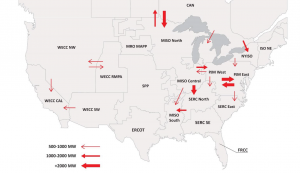
NERC recently published a reliability assessment of the final Clean Power Plan rule – Potential Reliability Implications of EPA’s Clean Power Plan – Phase II. The report finds that combined wind and solar capacity will rise by 10-20 GW over the next 15 years, while coal capacity will decline by up to 27 GW as a result of the CPP. The accelerated transition in the mix of generation resources means a greater emphasis on how renewables and other resources provide essential reliability services – voltage control, load ramping and frequency response.