Credentials: 
PhD
Credentials: 
PhD
Credentials: 
PhD
October 24th, 2016
USAID Reports
Program Publications

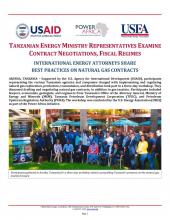
ARUSHA, TANZANIA – Supported by the U.S. Agency for International Development (USAID), participants representing the various Tanzanian agencies and companies charged with implementing and regulating natural gas exploration, production, transmission, and distribution took part in a three-day workshop. They discussed drafting and negotiating natural gas contracts, in addition to gas taxation.

October 19th, 2016
USAID Reports
USEA Documents

DAKAR, SENEGAL – Supported by the U.S. Agency for International Development (USAID), participants representing various agencies within the Senegalese energy sector took part in a four-day workshop on renewable energy project planning and finance. Topics discussed include: renewable energy policy implementation, grid management/optimization for renewables, and best practices for standard Power Purchase Agreements (PPA).  Participants ranged from international attorneys, energy investors and engineers to local government officials. The workshop was conducted by the U.S.

November 30th, 2016

There is a growing consensus among industry, the environmental community and governments that future CO2 emission reduction goals cannot be met by renewable energy sources alone and that carbon capture, utilization and storage (CCUS) technologies for all fossil fuels (coal, natural gas, oil) will have to be deployed to achieve climate objectives in the U.S. and globally. A commitment to deploying CCUS technologies begins with policies and incentives to level the playing field for CCUS, and includes advancing efforts to deploy CO2 utilization technologies and products. 


Job Title: 
Senior Policy Advisor
Organization: 
Third Way

Erin Burns is the Senior Policy Advisor for Third Way’s Clean Energy Program, where she manages the organization’s carbon capture work, clean energy legislative strategy, and energy innovation effort. Previously, Erin worked in the office of Senator Joe Manchin (D-WV) for four years managing energy, environment, labor, and agriculture policy. Her work there included staffing Senator Manchin on the Energy and Natural Resources Committee, including in his role as Chairman of the Subcommittee on Public Lands and as Ranking Member of the Subcommittee on Energy.

Job Title: 
Deputy Director- Climate, Environment, & Energy Efficiency
Organization: 
Department of Energy

Judi Greenwald is the Deputy Director for Climate, Environment, and Energy Efficiency in the Department of Energy’s Office of Energy Policy and Systems Analysis. In this capacity, she oversees technical, economic and policy analysis related to climate mitigation and resilience, environmental protection, and energy efficiency.  Ms. Greenwald also serves as a Senior Advisor to the Secretary for Climate Change. 

Ms. Greenwald has over 30 years of experience working on energy and environmental policy. Prior to joining EPSA, Ms. Greenwald worked for fifteen years at the Center for Climate and Energy Solutions (formerly the Pew Center on Global Climate Change), most recently serving as the Vice President for Technology and Innovation. There she oversaw the analysis and promotion of technology, business, state, regional and federal innovation in the major sectors that contribute to climate change, including transportation, electric power, buildings, and industry.

Ms. Greenwald co-convened the National Enhanced Oil Recovery Initiative, was a member of the Advisory Council of the Electric Power Research Institute, and has served on several National Academy of Sciences panels studying vehicles and fuels. She also served on the Resource Panel for the northeast Greenhouse Gas Initiative, the California Market Advisory Committee, as a policy advisor to the Western Climate Initiative, and the Midwest Greenhouse Gas Accord Advisory Group. Prior to her work at the Pew Center, Ms. Greenwald served as a senior advisor on the White House Climate Change Task Force and as a member of the professional staff of the U.S. Congress Energy and Commerce Committee, where she worked on the 1990 Clean Air Act Amendments, the 1992 Energy Policy Act, and a number of other energy and environmental statutes.

Earlier in her career, Ms. Greenwald worked as a Congressional Fellow with then-Senate Majority Leader Robert C. Byrd, an environmental scientist with the U.S. Nuclear Regulatory Commission, and an environmental engineer and policy analyst at the Environmental Protection Agency. Ms. Greenwald received a B.S in Engineering, cum laude, from Princeton University, and an M.A. in Science, Technology and Public Policy from George Washington University.

October 27th, 2016

This panel will discuss the Carbon Capture, Utilization and Storage Act (S. 3179), introduced by Sens. Heidi Heitkamp (D-ND), Sheldon Whitehouse (D-RI) and Shelley Moore Capito (R-WV). This act would remove the cap currently on the Section 45Q federal tax credit. In addition, it would increase the value for each ton of CO2 captured and stored from power plants and industrial facilities. Lawmakers from both parties have endorsed this major legislation as it promotes domestic energy security and reduces carbon emissions.

Job Title: 
Energy Policy Advisor
Organization: 
Senator Sheldon Whitehouse

Aaron Goldner has a Ph.D. in Earth, Atmospheric, and Planetary Sciences from Purdue University. His research focused on understanding climate impacts and sensitivity of carbon dioxide and non-carbon dioxide forcings in past, future, and modern climate by using global climate models. As a scientist, Goldner strives to promote evidence-based decision making by linking scientific research with practical applications. In addition, he shows a clear passion for education and training, stating that “we must put sustained efforts into developing students and training scientists who understand science and are also able to intersect their knowledge with applied research agendas aimed at addressing societal needs. I believe collegiate educators should be trained and exposed to the policy realm and how policy decisions are made if they are going to instill a suitable problem solving framework into young scientists.”

Pages