Advancing Modern Power through Utility Partnerships (AmpUp) is a USAID-funded program centered around peer-to-peer relationships and strong practitioner and stakeholder networks to support net-zero goals. Pathways to unlock a low-carbon economy include: 1) decarbonizing the power system; 2) reducing demand for energy; and 3) electrification of end-uses. Programming in the three areas will strengthen steps towards decarbonization in developing countries.
March 31st, 2023

Relations between electric utilities and the environmental movement have often been stressed. Now these entities are happily united on the latest megatrend in electricity supply: distributed energy resources, known by the acronym DER.

These are desirable for balancing the intermittency of renewables, mainly solar and wind. Also, they are the building blocks of the envisioned virtual power plant (VPP) — a favorite concept of the environmental community and which is supported by the Biden administration.

Job Title: 
Utility of the Future Manager
Organization: 
PSE&G
N/A
Profile Type: 
Speaker
March 30th, 2023

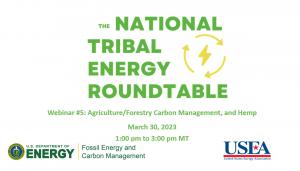
Discussion of Tribes and tribal members considering carbon management of farmland, ranchland and forest lands, including hemp. Carbon farming, a system of agricultural management, and sustainable forest management, helps the land sequester carbon. We will be starting a dialogue with the Idaho National Laboratory on the work they are doing in this space and how they can include Tribes and Tribal communities on this very important environmental work.

Job Title: 
Relationship Manager and Senior Scientist
Organization: 
U.S. Department of Energy’s Bioenergy Technologies Office

Dr. Lynn Wendt serves as the Laboratory Relationship Manager to the U.S. Department of Energy’s Bioenergy Technologies Office (BETO). Dr. Wendt is also a senior research scientist in the Energy and Environment Science and Technology Directorate at Idaho National Laboratory (INL). She has served as a principal investigator for multiple projects sponsored by BETO and has contributed to strategic planning for INL’s Biomass Feedstock National User Facility and associated programs. Dr. Wendt holds a bachelor’s degree in biochemistry from the University of Minnesota, a master's in biology from Idaho State University, and a Ph.D. in environmental science from the University of Idaho. Dr. Wendt is a bioenergy research expert in post-harvest physiology and chemistry of biomass storage systems and microbial systems for bioenergy feedstock supply chain processes. She has pioneered the development of biomass and algae material storage and handling systems that stabilize stored biomass materials while increasing biomass value during short- and long-term storage. Her 23 biomass-related publications and 2 patent applications are the authoritative reference on value-add biomass storage systems.

Credentials: 
Ph.D.
May 25th, 2023

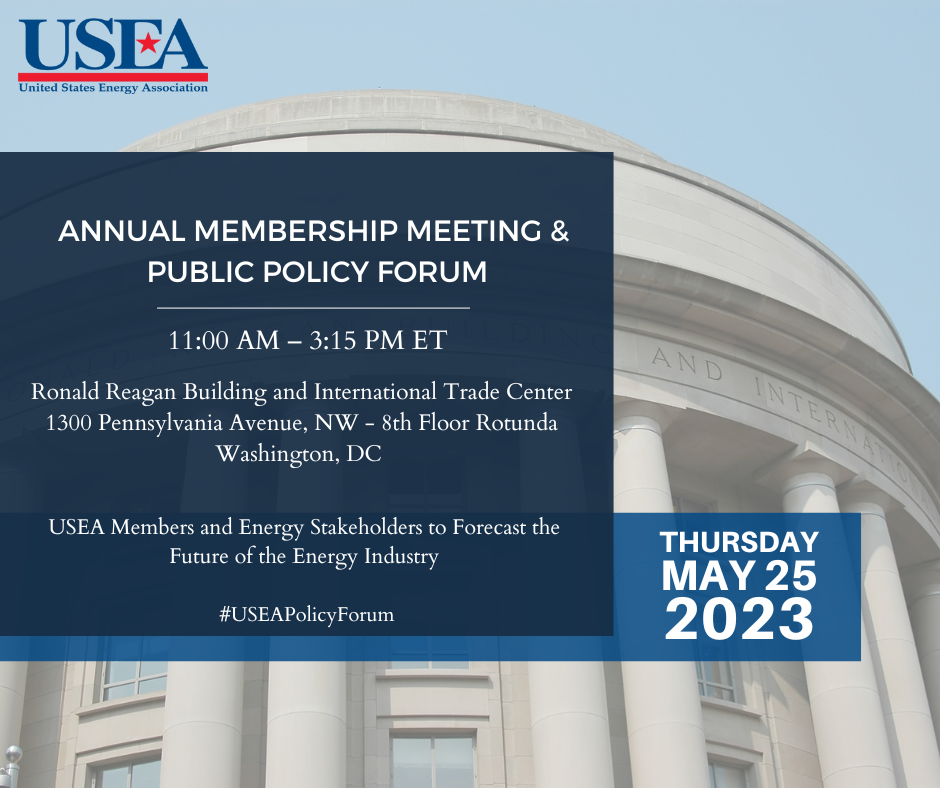
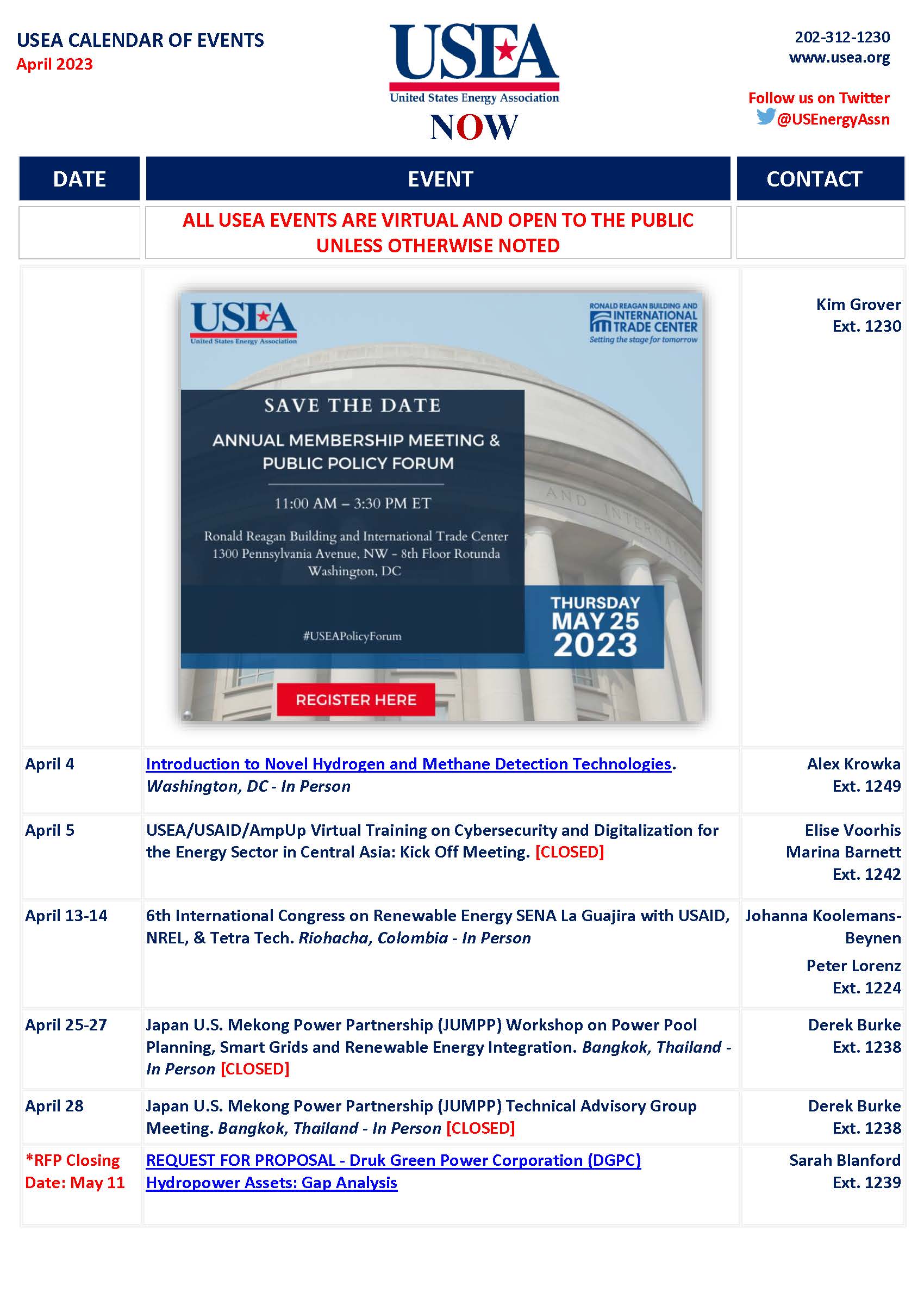
The State of the Energy Industry Forum is USEA's premier event. Held annually, chief executives from nearly every major energy trade association convene to share public policy objectives and priorities for the upcoming year.

Job Title: 
CEO
Organization: 
Agile Fractal Grid
John Reynolds serves as the CEO of the Agile Fractal Grid. He is responsible for the company’s operational functions as well as its technical strategies and plans. He is also co-chair of the Digital Twin Consortium for Utilities specializing in smart infrastructure for cities. Prior to operating the Agile Fractal Grid, Mr. Reynolds has been the Director of Systems Management at Honeywell, and the CEO of Integrated Architectures serving the Telecommunications industry. He was CIO for Empire Bank of New York. He served his entire military tenure at the United States Military Academy at West Point.
Profile Type: 
Speaker
Job Title: 
Senior Advisor (Virtual Power Plants)
Organization: 
Loan Program Office at U.S. Dept. of Energy (DOE)

David Nemtzow is the Senior Advisor at the U.S. Department of Energy (DOE). He has successfully run a large State government energy, water and utility department, a prominent non-profit energy efficiency association, and an energy and utility consulting practice; he has been on the executive team of a clean energy startup company and served as a senior Congressional aide. He has provided technical and policy advice to policy makers and regulators; forged partnerships and coalitions, advanced legislation and programs; and communicated complex energy issues to corporate CEOs, energy professionals, community leaders, senior government officials and the public. Inside organizations he has provided leadership, management and fundraising – building teams and generating results. In both the public and private sectors, he has brought together business, government, experts, advocates and others to improve the energy and utilities marketplace and regulatory environment. He has published and speaks extensively in the field. 
David has served on numerous governmental advisory committees and the boards of energy associations and organizations. He has published and speaks regularly in the field.

He earned a master's degree from Harvard University in public policy and a bachelor's from Brown University in environmental policy.

Profile Type: 
Speaker
Job Title: 
Former Chairman
Organization: 
Federal Energy Regulatory Commission (FERC)

Jon B. Wellinghoff  is an American attorney who served as the chairman of the Federal Energy Regulatory Commission (FERC) from 2009 to 2013. The FERC is a U.S. government agency that regulates the interstate transmission of electricity, natural gas, and oil. The FERC also reviews proposals to build liquefied natural gas (LNG) terminals and interstate natural gas pipelines and licenses hydropower projects.

Wellinghoff's work in energy-related fields has included renewable integration, plug-in electric vehicles, and the modernization of the American electric grid. In November 2013, Wellinghoff stepped down from his post as the 13th FERC chairman.

Wellinghoff was born in Santa Monica, California, on May 30, 1949, and moved to Reno, Nevada, at the age of four. He attended the University of Nevada-Reno, earning a B.S. in mathematics in 1971. The following year he earned a master's degree in teaching mathematics from Howard University and stayed in Washington, D.C., to attend Antioch School of Law where he earned his J.D. in 1975.

Wellinghoff returned to Nevada where he would specialize in energy law for more than 30 years. In private practice, he focused exclusively on cases pertaining to renewable energy and energy efficiency, causes he continued to promote as FERC Chairman. He was the primary author of Nevada's Renewable Portfolio Standard (RPS), one of two state RPS programs to receive an "A" rating from the Union of Concerned Scientists.

Wellinghoff has also held a variety of positions in the public sector, providing legal counsel on energy issues to, among others, the U.S. Senate Commerce Committee, the Federal Trade Commission and the Nevada Public Utility Commission.

Consumer protection was another hallmark of Wellinghoff's career prior to joining FERC. In his hometown of Reno, he held the position of Deputy District Attorney in the Washoe County District Attorney's Consumer Fraud division. His work on behalf of consumers helped make him Nevada's first Consumer Advocate for customers of public utilities. In that role, he argued for the public in cases before FERC, the Nevada Supreme Court and what is now the Nevada Public Utility Commission.

In 2006, Wellinghoff was appointed by President George W. Bush and confirmed by the Senate as one of the five commissioners at the FERC.

As commissioner, Wellinghoff was influential in moving FERC towards prioritizing the removal of barriers to integration of renewable energy into the electric grid. He has been an advocate of "demand response" and "smart grid" technologies that will facilitate coordination and communication between electricity consumers and providers, allowing consumers to have greater control over their energy usage and the associated costs.

Wellinghoff was an early proponent of improving energy infrastructure to accommodate future demands from automobiles powered primarily by electricity. He coined the phrase "Cashback Car" in a contribution to the Brookings Institution publication, "Plug-In Electric Vehicles: What Role for Washington?" In it, he envisioned a future where drivers not only save money by switching from gasoline but are paid by utilities for use of their batteries to provide and store electricity. Wellinghoff explained that while the necessary technology already exists, improvements to infrastructure will be needed to make the "Cashback Car" a reality.

In 2008, the Alliance to Save Energy honored Wellinghoff with its prestigious Charles Percy Award for Public Service. The non-profit group bestowed the award "in recognition of [his] decades of outstanding public service and his expertise and leadership on energy efficiency as the nation confronts the dual challenge of electricity supply security climate change."

During his time as commissioner, Wellinghoff also received the EnerNoc Thought Leadership Award at a summit on energy efficiency and the Award for Leadership in Demand Response from the U.S. Demand Response Coordinating Committee.
Profile Type: 
Speaker

Pages