
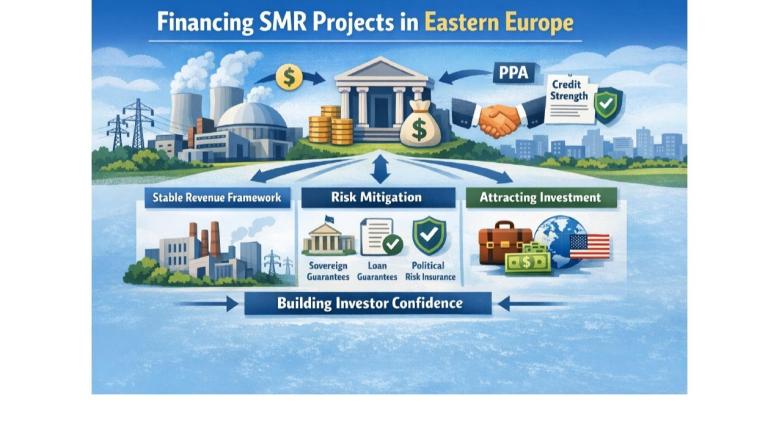
What will it take to Finance American SMR Projects in Eastern Europe?
William L. Polen, Senior Director, United States Energy Association
As with any independent power project the success of an SMR project depends on two things: how the project is structured, and whether the host country can provide a durable, bankable revenue framework that gives lenders and investors confidence they will be repaid.
The first issue is the project model. If the SMR is developed behind the meter for an industrial user, data center, district heating system, or other dedicated customer, the key question is whether that off-taker has the credit strength and contractual commitment to support the project’s long-term cash flow requirements. If the project is financed under a long-term bilateral power purchase agreement, bankability will turn largely on the purchaser’s creditworthiness, the enforceability of the PPA, indexation, curtailment protections, fuel-cost treatment, and the availability of sovereign or other credit support.
If, however, the project must sell a significant share of its output into a competitive wholesale power market, cost recovery becomes much more difficult. A first-of-a-kind or early SMR generally does not fit comfortably with merchant price exposure, because debt providers need predictable revenues over long periods, while wholesale markets typically produce volatile prices and may not compensate adequately for reliability, fuel security, or carbon-free firm capacity. In that case, the central question is not simply whether the power sector generates cash, but whether the market design and regulatory framework can convert the SMR’s value into stable revenues.
For most early SMR projects in Eastern Europe, the challenge is not simply recovering cost from electricity sales; it is allocating construction, licensing, political, and market risk to parties that can actually bear them.
That is why countries in Eastern Europe are not all alike. The stronger candidates are those that are closer to full cost recovery across the power sector, maintain tariff discipline, enforce payment collection, preserve regulator credibility, and can offer investors confidence that contracts will be honored over decades. Where those conditions exist, developers have a better chance of attracting private debt and equity at terms that are at least plausible relative to project risk.
Even in the stronger markets, however, most SMR projects will require risk-sharing mechanisms to become financeable. These can include sovereign guarantees; government-backed PPAs or contracts-for-difference; availability payments or capacity payments; loan guarantees; export credit support; concessional debt; grants for first-of-a-kind engineering, licensing, and site preparation; political risk insurance; and in some cases subordinated or cornerstone equity from public or quasi-public institutions. These tools do not eliminate risk, but they can shift enough of it away from private lenders and equity investors to make financing possible.
On the U.S. side, institutions such as EXIM and DFC can play important roles by supporting U.S. exports, reducing financing costs, and helping mitigate political and commercial risk. IFC can also be relevant where there is a credible private-sector transaction. More broadly, multilateral development institutions can help countries improve the enabling environment through grid investment, market reform, regulatory strengthening, and credit enhancement, even where they are not the primary source of reactor financing itself.
Better cost recovery requires more than fixing project finance. It requires building the wider conditions that make long-lived infrastructure investable: cost-reflective tariffs, credible regulation, dependable rule of law, disciplined state-owned utilities, politically durable nuclear policy, stronger grids, and mechanisms that compensate firm clean generation for the reliability and security value it provides.
In short, private capital will not avoid the region merely because it is Eastern Europe; it will avoid projects where revenues are uncertain, contracts are weak, and the state expects the market to absorb risks the market cannot price. So, the practical answer is this: the more a host government can convert an SMR from a merchant bet into a contracted infrastructure asset with stable revenues and credible public risk-sharing, the better the prospects for cost recovery and competitive financing. Where that cannot yet be done, the project is more likely to depend on sovereign balance sheets, strategic donor support, or a phased approach that begins with public-sector de-risking before large-scale private capital can enter.