U.S. DOE - Office of Fossil Energy & Carbon Management
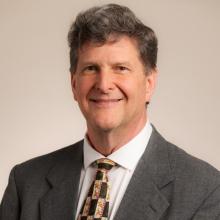
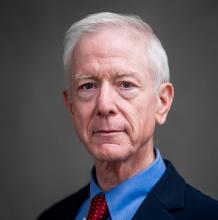
Rory Jacobson is a Division Director for the Office of Fossil Energy and Carbon Management (FECM). In previous roles at DOE, Jacobson has supported and coordinated FECM’s carbon removal and management programs and projects.
Prior to joining DOE, Jacobson was a Deputy Director of Policy at Carbon180, where he managed the federal policy portfolio for engineered carbon removal pathways. He has supported carbon removal and management research and analysis at non-governmental organizations, including the Natural Resources Defense Council and the World Resources institute. Jacobson received his master’s in environmental management from the Yale School of Forestry, where he was a Kerry Fellow.
U.S. DOE - Office of Fossil Energy & Carbon Management
Robert Schrecengost serves as a distinguished leader within the Department of Energy's Fossil Energy sector, driving innovation and policy advancements in the realm of fossil fuels. With a robust background in engineering and energy management, Robert has consistently championed initiatives that bridge the gap between traditional energy sources and sustainable practices.
Throughout his career, Robert has held pivotal roles within the Department of Energy, leveraging his expertise to shape strategic objectives and spearhead transformative projects. His dedication to enhancing the efficiency and environmental sustainability of fossil energy production has earned him widespread recognition and respect within the industry.
As an advocate for technological advancements, Robert has been instrumental in fostering collaborations between government agencies, research institutions, and private sector stakeholders. By fostering a culture of innovation and collaboration, he has facilitated the development and deployment of cutting-edge technologies aimed at reducing emissions, increasing energy security, and promoting economic growth.
Robert's leadership extends beyond the confines of his professional duties, as he actively engages with industry associations, academic institutions, and advocacy groups to promote dialogue and drive consensus on critical energy issues. His commitment to excellence and his passion for advancing the nation's energy agenda underscore his status as a trusted advisor and influential figure within the Department of Energy and the broader energy community.
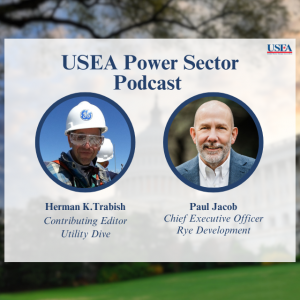
In this final episode of the USEA Power Sector Podcast series on energy storage, Paul Jacob, CEO of Rye Development, answered questions by journalist Herman K. Trabish about how closed loop pumped storage hydropower, or PSH, fits into the broad spectrum of mechanical energy storage, the enormous capacity potential of PSH, where it is already in use, what its cost benefit economics are, and why closed loop technology solves some of conventional hydropower’s environmental concerns.
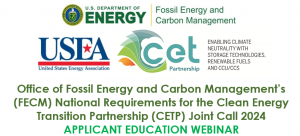
The Clean Energy Transition Partnership (CETP) is a collaboration of national and regional research, development, and innovation programs in the European Member States, Horizon Europe Associated Countries, Associated Partners, and non-Associated Partners. CETP supports the implementation of strategic energy and climate plans, with the ultimate objectives to:
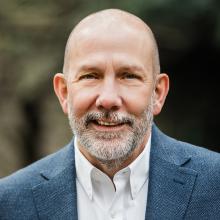
Paul serves as Rye’s CEO. Paul brings more than 30 years of executive experience to Rye’s team, stemming from previous roles in the energy sector. While at Rye’s predecessor, Free Flow Power, Paul helped the company pivot to conventional hydropower, with responsibility on projects and corporate development focusing on governmental and stakeholder outreach. He spent 10 years at Edison Mission Energy Group, as president of marketing and trading, managing an $8 billion portfolio of wind, coal and natural gas-fired generation. Prior to Edison, Paul built Citizens Energy Company’s energy management and marketing venture and defined its electricity marketplace platform. Paul holds a BFA from the Rhode Island School of Design.
John has over 30 years of experience taking novel solutions from conception to reality across the energy, semiconductor and supercomputer industries. Prior to founding Rondo, John served as co-founder and vice president of development for GlassPoint Solar, which delivered solar industrial heat worldwide. He previously cofounded and led Ausra, a pioneer in solar thermal electric systems. John served as a lead engineer for Princeton Plasma Physics Laboratory, where he designed award-winning technology to support fusion experiments. He is a published author of numerous technical papers and holds more than 20 patents in the U.S. and internationally. John earned a B.Sc. with Special Distinction in Computer Science from Yale University.
In episode of the USEA Power Sector Podcast’s series on energy storage, John O’Donnell, CEO of Rondo Energy, answered questions from journalist Herman K. Trabish about the thermal energy storage technologies that capture and store heat, the mechanics of thermal energy storage and Rondo’s “heat battery,” about why this concept may be vital to eliminating carbon emissions, and what may be just over the horizon for Rondo and other thermal energy storage technologies.
The United States Energy Association (USEA) is inviting prospective organizations or individuals through this Request for Proposal (RFP) to submit proposals for English – Russian interpretation and translation services in support of a cybersecurity project for an energy stakeholder in Kazakhstan.
Proposals are due by 17:00 hours EST of the closing date. Please submit all proposals with a read receipt to Ms. Marina N. Barnett, Program Manager, at [email protected]. Proposals must be in digital format (PDF).
The United States Energy Association (USEA) is inviting prospective organizations or individuals through this Request for Proposal (RFP) to submit proposals for a project on Bolstering Kazakhstan’s National Security Through Electricity Market Cybersecurity.
Proposals are due by 17:00 hours EST of the closing date. Please submit all proposals with a read receipt to Ms. Marina N. Barnett, Program Manager, at [email protected]. Proposals must be in digital format (PDF).