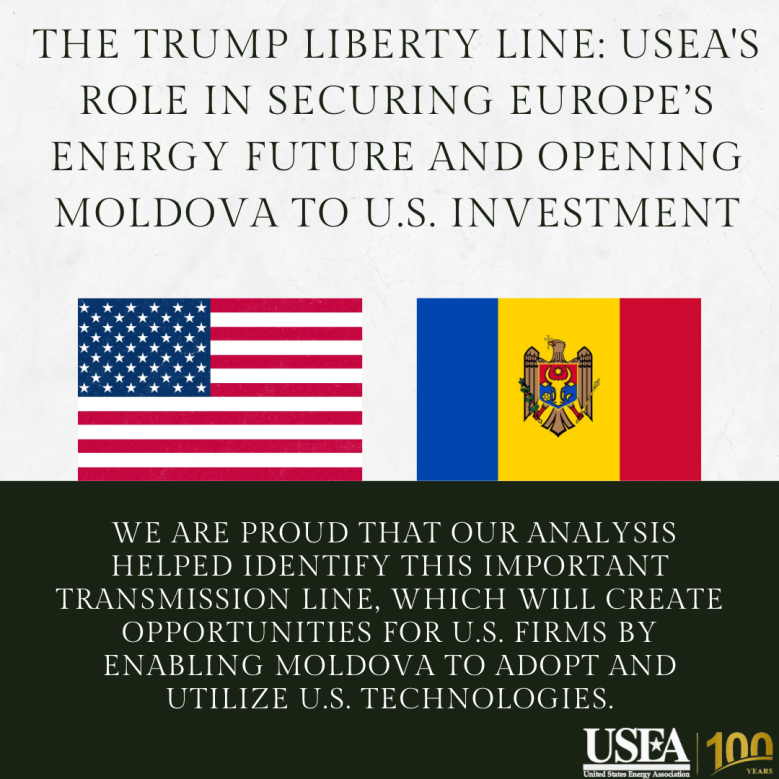
The Trump Liberty Line: USEA's Role in Securing Europe’s Energy Future and Opening Moldova to U.S. Investment
The Trump Liberty Line: USEA's Role in Securing Europe’s Energy Future and Opening Moldova to U.S. Investment
By Will Polen, Senior Director, United States Energy Association
The Strășeni–Gutinaș 400 kV interconnection between Moldova and Romania has taken another step toward construction. The United States and Moldova have set up a working group to move the project forward, and the line is now being called the “Trump Liberty Line.” The U.S. Government is putting $130 million toward the Moldovan portion, which will give Moldova a second direct link to Romania and the wider European electricity system. That means better energy security, a sturdier grid, and access to competitive European power markets.
The United States Energy Association (USEA) helped get the project here. Working with the transmission system operators in Moldova and Romania, USEA analyzed the technical and economic case for three possible 400 kV interconnections. Strășeni–Gutinaș came out as the strongest option, and USEA’s study gave the U.S. Government the data it relied on when it approved the $130 million investment. What started as transmission planning and system modeling is now heading toward physical infrastructure.
The U.S. Government’s approval of this critical investment represents a strong commitment to Moldova’s energy future and its continued integration with the European energy markets. USEA is excited to see the significant progress being made toward a more resilient energy system for Moldova, and we are proud that our analysis helped identify this important transmission line, which will create opportunities for U.S. firms by enabling Moldova to adopt and utilize U.S. technologies.
Once built, the line will let Moldova import electricity from European markets and lean less on power from Russian-owned plants, while making its grid more stable. It also lays the groundwork for broader regional cooperation on energy trade. For the U.S., the project shows what sustained technical assistance and investment can do: strengthen Moldova’s energy security, tie it more closely to European energy markets, make it less exposed to energy coercion, and make it a more appealing place for U.S. investment in power generation and other energy infrastructure.