
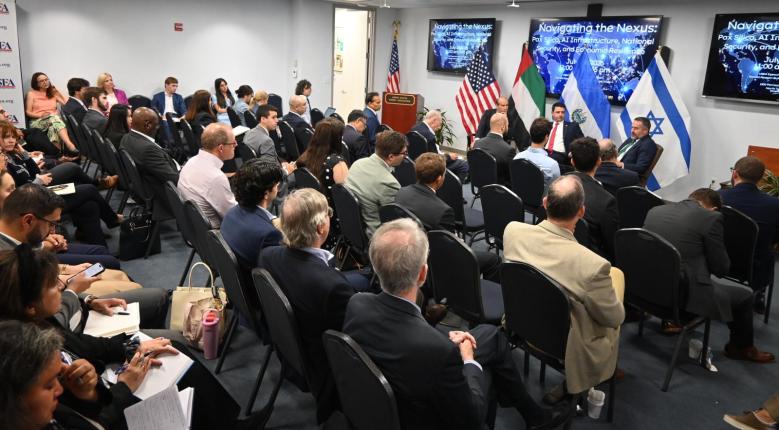
USEA Hosts Forum Examining Energy, Infrastructure, and National Security in the Era of Pax Silica
WASHINGTON, D.C. — The United States Energy Association (USEA) today hosted a forum, "Navigating the Nexus: Pax Silica, AI Infrastructure, National Security, and Economic Resilience," bringing together high-level leaders across energy, defense, and international diplomacy to address the critical power requirements driving artificial intelligence and technological sovereignty.
"We are operating in the era of Pax Silica, a geopolitical paradigm where global stability, national security, and economic dominance are entirely dependent on securing semiconductor supply chains and the massive energy generation required to run them," said USEA President & CEO Mark Menezes. "The race for AI capability is accelerating at an unprecedented pace, but you simply cannot compute without electricity."
The morning session featured a keynote discussion on strategic leadership in the age of AI. Joined by Tommy Joyce, Associate Administrator for Strategic Partnerships at the National Nuclear Security Administration (NNSA), and Todd Snitchler, President & CEO of the Electric Power Supply Association, the panel examined how the rise of AI shifts the stack, from critical minerals and nuclear capabilities to gigawatt-scale data centers, into the realm of core national defense.
Following that was a panel on the nexus of power, security, and economic dominance featuring Special Competitive Studies Project’s Senior Director for Tech Leadership David Lin, Meridian International Center’s Vice President for the Center for Technology, Innovation & Space Kellee Wicker, and the Digital Power Network’s Executive Director Smythe Anderson. The speakers examined how the global shift from oil to silicon reshapes economic power, focusing on scaling energy infrastructure to meet massive AI demands without straining grids, securing expansive global tech networks, and counteracting foreign supply chain weaponization.
The closing panel focused on the diplomatic and policy foundations needed to align AI infrastructure across borders, featuring Jawaher Almheiri, UAE Commercial Attaché to the U.S. and Head of Economic Policy at the UAE Embassy; Carlos Pineda Cruz, Minister Counselor at the Embassy of El Salvador; and Shay Podoler, Director of Regulatory and Trade Policy at the Economic and Trade Mission of Israel. Panelists explored how allied nations can collaborate on cross-border compute capacity, streamline trade policy to avoid red tape, harmonize international AI standards, and cultivate the talent needed to sustain next-generation energy and technology ecosystems.
“The forum underscored USEA's ongoing mission to serve as a bridge between the public and private sectors, solving complex energy security challenges and establishing the physical energy layer necessary to maintain national security and global economic resilience,” said Melissa Brown, a Senior Program Coordinator at USEA who put together the event.

(l to r): Mark Menezes, President & CEO of USEA; Tommy Joyce, Associate Administrator for Strategic Partnerships at the National Nuclear Security Administration (NNSA); and Todd Snitchler, President & CEO of the Electric Power Supply Association (EPSA).

(l to r): Kellee Wicker, Vice President for the Center for Technology, Innovation & Space at Meridian International Center; David Lin, Senior Director for Tech Leadership at the Special Competitive Studies Project; and Smythe Anderson, Executive Director of the Digital Power Network.

(l to r): United Arab Emirates Commercial Attaché to the U.S. and Head of Economic Policy Jawaher Almheiri; Embassy of El Salvador Minister Counselor Carlos Pineda Cruz; and Director of Regulatory and Trade Policy, Economic and Trade Mission of Israel Shay Podoler.