
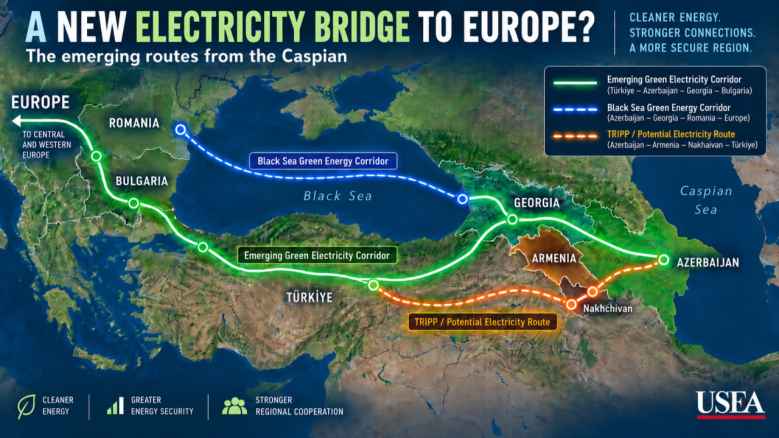
A new electricity bridge to Europe? The emerging routes from the Caspian and where Armenia fits
A new electricity corridor may be taking shape between the Caspian and Europe. Türkiye and Azerbaijan are advancing several major transmission initiatives, including a connection through Nakhchivan to Türkiye, a Türkiye-Azerbaijan-Georgia-Bulgaria Green Electricity Corridor, and expanded access to Europe through the Black Sea. Ankara hopes to advance the four-country corridor at COP31 in November, signaling that electricity trade is becoming an increasingly important dimension of regional energy cooperation.
The Black Sea route offers a useful precedent. USEA supported a pre-feasibility assessment of the proposed Georgia-Romania submarine cable that examined whether the two transmission systems could accommodate the interconnection and what system upgrades would be required. That early analytical work helped establish the technical basis for the concept and contributed to subsequent World Bank financing for a full project feasibility study.
The progression illustrates the importance of early-stage technical analysis in moving regional transmission concepts toward serious infrastructure development and raises the question of which of today’s competing east-west routes will receive the same momentum.
For Armenia, this is especially important. TRIPP offers the possibility of connecting Azerbaijan through Armenia to Nakhchivan and Türkiye, potentially creating another east-west route for energy infrastructure and electricity trade. Yet the transmission projects now receiving the greatest attention from Ankara and Baku largely run through Georgia, including the proposed Türkiye-Azerbaijan-Georgia-Bulgaria power link, while the Black Sea cable offers another path from the Southern Caucasus directly into Europe.
These developments underscore the importance of integrating it into the region’s emerging electricity architecture. A transmission route linking Azerbaijan through Armenia and Nakhchivan to Türkiye could give Armenia a meaningful role in a broader Caspian-to-European corridor.