
October 27th, 2020

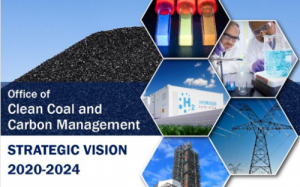
The U.S. Department of Energy's Office of Clean Coal and Carbon Management (OCCCM) released it's Strategic Vision 2020-2024 in August of this year and on September 14, USEA hosted OCCCM to present it to the public. A recording of the presentation and a copy of the document are available here.

October 26th, 2020

The U.S. Department of Energy's Office of Clean Coal and Carbon Management (OCCCM) released it's Strategic Vision 2020-2024 in August of this year and on September 14, USEA hosted OCCCM to present it to the public. A recording of the presentation and a copy of the document are available here.

October 23rd, 2020

In this issue:

  • Executive Chairman Vicky Bailey Named WCEE 2020 Champion
  • In Memoriam: Barry K. Worthington
  • 2nd Annual Advanced Energy Technology Forum Recap
  • Women In Energy: Kathy Curtis
  • Dan Yergin's New Book
October 21st, 2020
USEA Documents

The United States Energy Association (USEA) is inviting prospective organizations, including consultants, traders, power exchanges, and training institutes, or individuals through this Request for Proposal (RFP) to submit proposals for developing and delivering a comprehensive training on the creation and operations of a power exchange for South Asian energy officials.

October 27th, 2020

Please join the U.S. Energy Association (USEA) and the U.S. Agency for International Development (USAID) for the third installment of the Geothermal Industrial Park webinar series presented by the U.S.- East Africa Geothermal Partnership (EAGP).

The goal of a geothermal industrial park (GIP) is to achieve a circular or zero waste approach where all resources are used sustainably for the benefit of the local community. Increased innovation and resource recovery through the elimination of material leakage help maximize the economic value of natural resources such as geothermal.

October 23rd, 2020
During this virtual press briefing, our guest speakers will examine energy after the 2020 election and answer questions from the media.
Job Title: 
Associate Director of Intelligence Programs
Organization: 
Electricity Information Sharing and Analysis Center (E-ISAC)

Associate Director of Intelligence Programs and Director of the Cybersecurity Risk Information Sharing Program (CRISP) 

Electricity Information Sharing and Analysis Center (E-ISAC)

Frank Honkus is the Associate Director of Intelligence Programs and the Director of the Cybersecurity Risk Information Sharing Program (CRISP) at the Electricity Information Sharing and Analysis Center (E-ISAC). Frank supports the cybersecurity of electric utilities members of CRISP through ensuring growth of the program and refinement of technical capabilities, reporting, and information sharing. Prior to joining the E-ISAC, Frank supported the Department of Energy’s Office of Intelligence and Counterintelligence analyzing CRISP data for anomalous and malicious cyber activity. He was the red team lead and wrote the foundational mitigation and recovery sections for the Joint Base Architecture for Security Industrial Control Systems (J-BASICS) Joint Test, and supported the United States Cyber Command focusing on cyber threats to operations technology systems. He attained his Masters in Public and International Affairs (MPIA) with a major in Security and Intelligence from the University of Pittsburgh’s Graduate School of Public and International Affairs, and received a dual major in History and Political Science from the University of Pittsburgh.

Profile Type: 
Speaker
Secondary Job Title: 
Director of the Cybersecurity Risk Information Sharing Program (CRISP)
Secondary Organization: 
Electricity Information Sharing and Analysis Center (E-ISAC)
October 21st, 2020

Join the Global CCS Institute and USEA, with support from the Department of Energy’s Office of Fossil Energy, on October 21st and 22nd, as we explore opportunities to deploy CCS projects in Texas.

The momentum and vital need for carbon capture and storage (CCS) technologies has never been greater. With a strong industrial base and the highest CO2 emissions of any state, Texas needs CCS to compete in a decarbonizing world. And CCS needs Texas, with its prime geology, business experience, and political support for this critical technology.

Pages