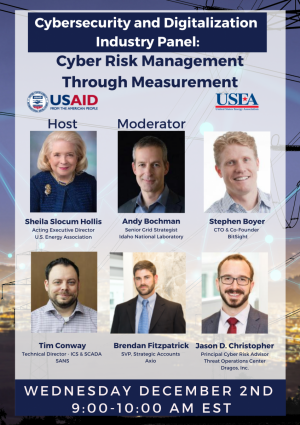
December 2nd, 2020

The 15-part Cybersecurity and Digitalization webinar series was launched in June 2020 to educate utilities on cyber standards, trends, and best practices. The series reached over 4,200 participants from 70 utilities in 68 different countries.

Following the success of the webinar series, USEA and USAID will host industry panels with leading cybersecurity experts. The panelists will present trends in cyber-attacks to global power sector stakeholders and discuss the latest innovative tools and technologies.

Job Title: 
Executive Director
Organization: 
Partnership For Carbon Accounting Financials (PCAF)

Giel Linthorst is a director, leading all activities in the field of science-based targets and sustainable finance. He is a global recognized expert on translating climate science to corporate strategies and financial institutions.

Giel was the leading expert who developed the new, ground-breaking methodology for the Science Based Targets initiative of CDP, UN Global Compact, WRI and WWF. This methodology was peer-reviewed and published in Nature Climate Change and referred to in many other publications. Together with CDP, WRI, WWF and 2o investing initiative, Giel is developing a harmonized framework to set science-based targets for the financial sector and align a financial portfolio with the Paris Agreement.

Giel has supported various financial institutions on carbon accounting of their loans and investments, developing climate strategy and performing scenario analysis and climate risk assessment. Additionally, he is part of the Dutch High Level Expert Group on Sustainable Finance and was the leading expert on a high-level project for the German government, as part of their G20 presidency, (1) to assess the carbon risks in the German economy, (2) to conduct a carbon stress test for German financial institutions and (3) to develop regulatory instruments to mitigate carbon risks in financial markets in Germany and beyond.

Giel is a common speaker at various conference, like UN Climate Change Conference (COP), Climate Leadership Conference or Responsible Investment conference. He has presented his key expertise and vision in various online webinars. Giel has a technical and physical background combined with strategic business development. During his career at Guidehouse he has established a broad network among companies, financial institutions, well-known NGOs (such as CDP, WRI and WWF) and climate scientists.

Prior to his current role Giel was manager of the unit sustainable products, and was also ad-interim unit manager of the Sustainable Transport unit. As manager of both units, he was involved in setting up ambitious climate and energy policies and corporate environmental strategies together with policy actors and well known NGOs, as well as supporting companies to measure, improve and report their environmental performance. He has gained experience in achieving sustainability in various sectors. With his expertise, he ensures that the developed strategies are translated into clear, effective and impactful actions.

Profile Type: 
Speaker
Job Title: 
Director of Impact Policy
Organization: 
Amalgamated Bank
Profile Type: 
Speaker
November 9th, 2020
External Reports
The November 2020 issue of Public Utilities Fortnightly.
December 11th, 2020

Electric utilities are heavily dependent on sensors and growing interconnectivity. Smart meters, dispersed generation, variable generation -- like wind and solar -- require real-time data streams in order to make the split-second adjustments on the grid. Likewise in aberrant weather and other disaster scenarios, such as wildfires, uninterruptible communications are essential for utilities. How should they build communications systems that won't fail if the internet goes down, or if they are under cyberattack? How can utilities be sure that 5G won't make whatever system they decide to build obsolete?

Job Title: 
Director, Center for Negative Carbon Emissions
Organization: 
Arizona State University

Klaus Lackner is the director of Center for Negative Carbon Emissions and professor at the School of Sustainable Engineering and the Built Environment of the Ira A. Fulton Schools of Engineering, Arizona State University. Lackner’s research interests include closing the carbon cycle by capturing carbon dioxide from the air, carbon sequestration, carbon foot-printing, innovative energy and infrastructure systems and their scaling properties, the role of automation, robotics and mass-manufacturing in downscaling infrastructure systems, and energy and environmental policy. His interest in self-replicating machine systems has been recognized by Discover Magazine as one of seven ideas that could change the world. 

In 1999, Lackner was the first person to suggest the artificial capture of carbon dioxide from air in the context of carbon management. His recent work at Columbia University as director of the Lenfest Center for Sustainable Energy advanced innovative approaches to energy issues of the future and the pursuit of environmentally acceptable technologies for the use of fossil fuels.

He is a fellow of the American Association for the Advancement of Science and he was recognized for contributing to the 2007 Nobel Peace Prize for the IPCC. He is also a member of the steering committee for the Earth Institute at Columbia University.

Education

Ph.D. Physics (Theoretical Particle Physics) Summa Cum Laude), Heidelberg University, Germany 1978 Clemm-Haas Prize for outstanding Ph. D. thesis at Heidelberg UniversityDiplomPhysics, Heidelberg University, Germany 1976 Advisors: Professors John Grace and Xiaotao Bi)VordiplomPhysics, Heidelberg University, Germany 1975

Profile Type: 
Speaker
November 13th, 2020
During this virtual press briefing, our guests speakers gave insight on this new financial industry effort to measure the carbon impact of loans and investments as a building block for further climate action.
Job Title: 
Associate, Global Standards Strategy
Organization: 
American Petroleum Institute

Ryan Nelson is an Associate in API’s Global Industry Services division, where he helps lead the association’s Global Standards Strategy. In this role, Ryan engages with international stakeholders to promote collaboration on the use of industry standards to improve environmental, health, safety, and sustainability performance globally. Prior to API, Ryan served in numerous policy advisory roles in the U.S. Senate and House of Representatives, primarily handling national defense, technology, and foreign policy through the House Energy and Commerce Committee and the Senate Armed Services Committee. Ryan also served in the U.S. Army National Guard for six years as a Chemical, Biological, and Nuclear Specialist. He holds a BS degree in Finance from North Dakota State University.

Profile Type: 
Speaker

Pages